


Most mid-market 3PL operations leaders we talk to know they have billing leakage. Few of them know how much. The number we typically uncover when we run an event-by-event audit is somewhere between 6 and 9 percent of total billable revenue. On a $20 million 3PL that is roughly $1.2 to $1.8 million a year that should already be in the bank. Here is where it goes — and what to fix first.
The 3PL Billing Leakage Audit: Where Mid-Market 3PLs Quietly Lose 6 to 9 Percent of Revenue
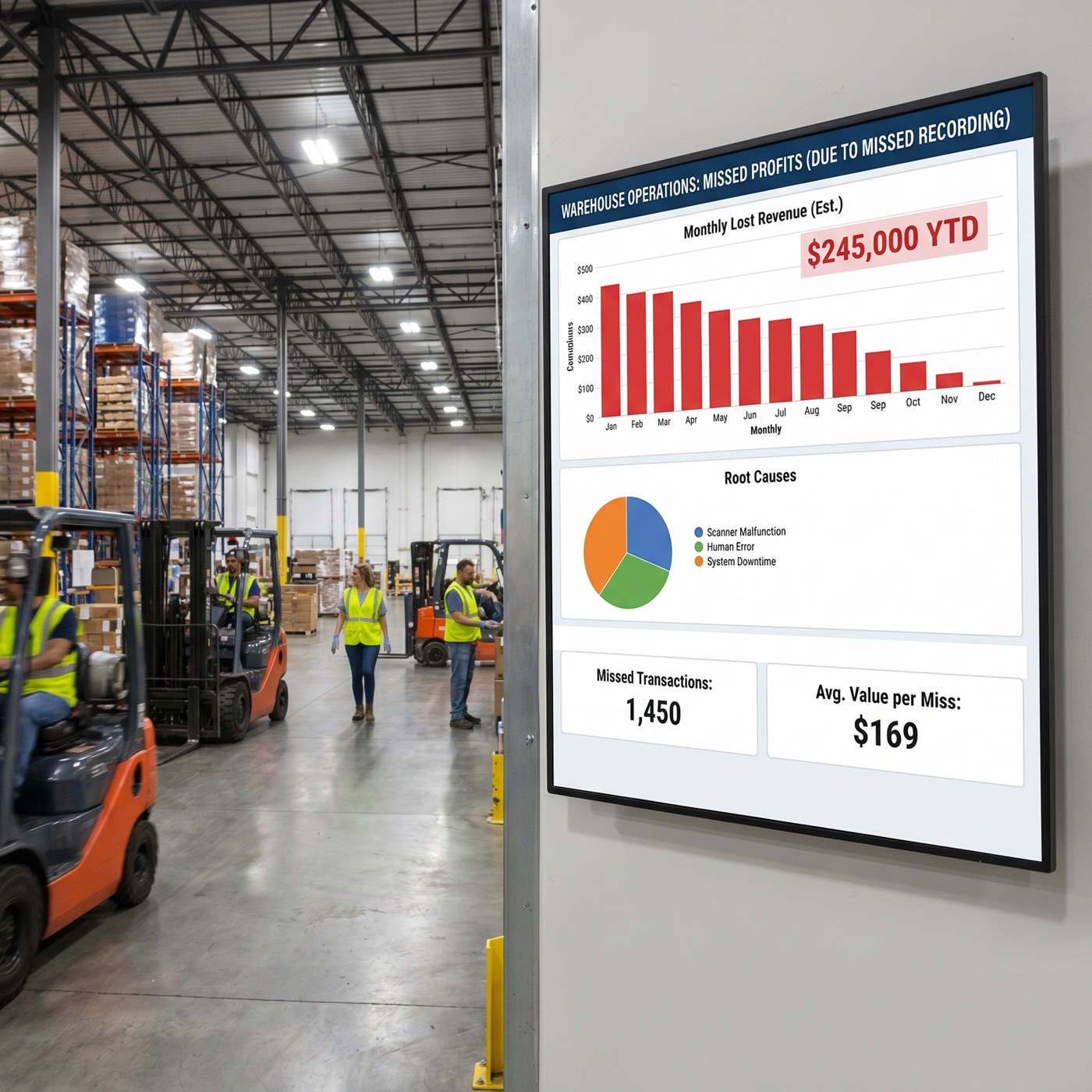
Where the Leaks Hide
Billing leakage is rarely one giant problem. It is usually six small ones, all of which are individually easy to dismiss as "just how things have always worked." When you add them up they are the difference between a profitable 3PL and a struggling one.
1. Accessorial Events That Never Get Captured
Pallet wrapping, labeling, kitting, special handling, after-hours work, drayage, detention. The work happens on the floor. The billing event never makes it into the system, because nobody scanned anything when it happened, or because the operator was supposed to write it down on a clipboard that lives in the back office. Anywhere you have a manual log of work-as-performed, you almost certainly have leakage.
2. Storage Cycles Calculated From Yesterday's Snapshot
If your billing run uses month-end inventory snapshots instead of daily pallet position counts, you are undercharging clients whose inventory peaked mid-month and was gone before the snapshot. Storage fees should be calculated from cycle-accurate daily snapshots inside the WMS, not after the fact in spreadsheets.
3. Detention Fees That Never Get Billed Through
Detention is the clearest example of billable work that quietly costs a 3PL real money. When a customer's trailer sits on the dock past the free time — whether that's a driver waiting hours to get unloaded or a customer's equipment sitting in the yard — the 3PL is on the hook for the carrier's charge. Those bills arrive from the carrier after the fact, often 30 to 60 days later, and far too often they land in the 3PL's cost column instead of the customer's invoice. Log every detention event in the WMS the moment it starts, tie it to the customer and trailer it belongs to, and automate the pass-through so the cost is billed at invoice time, not written off quietly at month-end.
4. Returns Processing That Goes Through For Free
Returns are work. Receiving the return, inspecting it, putting it back to stock or quarantining it, restocking the pick face — every one of those is a billable handling event in most 3PL contracts. We routinely see 3PLs absorbing the entire returns workflow because the WMS treated returns as a special case nobody set up the rates for.
5. Ad-Hoc Customer Requests That Never Hit a PO
"Can you pull these 30 SKUs and stage them by tomorrow morning?" The work happens. The customer is grateful. Nobody invoices it because there was never a purchase order. A WMS that lets operations log a billable event against a customer in 10 seconds — without waiting for a PO — closes this leak permanently.
6. Annual Rate Increases That Never Get Applied
Most 3PL contracts have an annual escalation clause, typically 3 to 5 percent. Most 3PLs forget to apply it on the contract anniversary. A billing engine that tracks contract effective dates and pushes the new rates automatically on the right day recovers a percent or two of total revenue with zero customer friction, because the increase was already in the contract the customer signed.
How to Run the Audit Yourself
You do not need a consultant for this. You need three things and an afternoon:
- A list of every accessorial line item in your client contracts. Compare to what your billing system actually invoiced last month. Anything in the contract that is not on an invoice is leakage.
- Cycle-accurate daily inventory positions for one client for the last 30 days. Calculate storage fees against the daily peak instead of month-end. The delta is your storage leakage.
- A sample of operator activity from the floor — anything that took more than 10 minutes that was not a standard receipt, putaway, pick, or ship. Match each item to a billable event in the system. Anything unmatched is leakage.
In most 3PLs the audit takes one operations leader, one billing analyst, and four hours. The output is the most valuable data set in the company.
What to Fix First
If your audit shows 6+ percent leakage, the highest-ROI fix is almost always automated event capture at the point of work — every accessorial event recorded the moment it happens, with no clipboard, no end-of-shift summary, no monthly reconciliation. Everything else (storage cycle math, contract escalation tracking, returns billing) is downstream of getting the events into the system in the first place.
If you would like to walk through the audit on your own data, with someone who has done it for 3PLs running anywhere from 30,000 to 5 million square feet, reach out to SC Codeworks. We will tell you what we find — even if the answer is that you do not need a new WMS.
Related Reading
WMS Pricing Guide: What a mid-market 3PL WMS actually costs — the five cost lines, and the questions to ask every vendor before you sign.
WMS Glossary: Plain definitions for accessorial charges, storage fees, multi-client billing, value-added services.
Stop Leaking Billing Revenue?
SC Codeworks automated billing event capture is built for mid-market 3PLs.
Schedule A Billing Demo