Increasing Picking Efficiencies: What Takes a Warehouse to the Next Level?
SC Codeworks Team
In today's competitive market, customers expect rapid and accurate order fulfillment. Any delays or errors in the picking process can lead to dissatisfied customers, increased returns, and a tarnished reputation. Therefore, it is imperative to implement strategies that streamline picking operations and ensure that orders are processed swiftly and accurately.
Efficient picking processes are essential for maintaining high order fulfillment speeds, reducing labor costs, minimizing order errors, and ultimately enhancing customer satisfaction. As a Warehouse Management System (WMS) vendor, we understand the intricacies of optimizing picking processes and are here to share insights on what it takes to elevate your warehouse to the next level.
Picking Efficiency Strategies
By incorporating these strategies and methods, you can further enhance the efficiency of your warehouse picking processes. Each of these examples offers unique benefits and can be tailored to fit the specific needs of your operation.
Map Routing
One of the most effective ways to enhance picking efficiency is through advanced routing. Implementing a WMS with sophisticated route optimization logic can significantly reduce the time pickers spend navigating the warehouse. By directing pickers through the most efficient paths and eliminating backtracking, you can streamline operations and boost productivity.
Batching
Order batching is another powerful strategy to improve picking efficiency. When possible, you can consider utilizing any of the following methods:
Zone Picking: Assign pickers to specific zones within the warehouse to fulfill orders for items located within those zones. This reduces travel time and increases specialization.
Wave Picking: Release batches of orders at specific intervals to optimize workflow and resource allocation. This method ensures that pickers are always working on the most critical tasks.
Batch Picking: Pick multiple orders simultaneously, grouping items from different orders together to minimize travel time. This method is particularly effective for high-volume operations
Identify Fast/Slow-Moving Inventory
ABC inventory analysis is a valuable tool for categorizing inventory based on sales velocity and value.
A-items (High-value, high-demand): Store these items in easily accessible locations for quick and efficient picking. These could be candidates for a pick line or pick front
B-items (Moderate value and demand): Store these items in less accessible locations than A-items.
C-items (Low-value, low-demand): Store these items in remote or less accessible areas of the warehouse, such as top racks or bulk locations at the back.
Consider Different Picking Methods
Different picking methods can further enhance efficiency. By adopting various techniques, you can tailor the picking process to better suit your warehouse's specific needs
Pick Lines: Also known as pick-face or pick-front, this method is used for fast-moving items that are piece-picked.
Pick-to-Light Systems: Guide pickers to the correct items using visual cues (lights) and displays, reducing errors and speeding up the process.
Voice-Directed Picking: Utilize voice commands to guide pickers through the picking process, minimizing the need for manual data entry and reducing errors.
Reduce Travel Time
Optimizing the warehouse layout is crucial for reducing travel time. A well-organized layout ensures that pickers can move quickly and efficiently through the warehouse
Single-depth vs. Double-depth Racking: Consider the trade-off between space utilization and ease of access
Wide Aisle: Allow for easy movement of equipment and personnel, reducing the risk of collisions and improving safety.
Zones: Identifying locations by zone will help determine product placement and the equipment used in the picking process
How to Measure Picking Efficiencies
Measuring picking efficiency in a warehouse involves tracking several key performance indicators (KPIs) that provide insights into the effectiveness of your picking processes. Here are some of the most important KPIs to consider:
Picking rate measures the number of items picked per hour. This KPI helps you understand the productivity of your workforce. It can be calculated as:
A higher picking rate indicates more efficient picking operations.
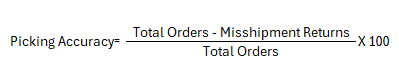
Picking accuracy shows the percentage of orders picked correctly without errors. It can be calculated as:
High picking accuracy reduces returns, complaints, and rework, leading to better customer satisfaction.
Order picking cycle time is the duration between receiving an order and preparing it for shipping. This KPI demonstrates the efficiency and flexibility of your order-picking process. It includes the time taken for order receipt, assignment, picking, packing, and shipment.
Picking utilization measures how much of the available picking capacity is being used. It shows how effectively you are managing your picking resources. Higher utilization indicates that your pickers are working efficiently and making the most of your warehouse space, equipment, and labor.
Pick quality measures how well your picking process meets customer needs and expectations. Higher quality means that items are handled correctly, packed well, and meet customer specifications.
Cost per pick calculates the total cost associated with picking an item. This includes labor, equipment, and any other related expenses. Lowering the cost per pick can significantly improve overall warehouse efficiency and profitability.
Travel time measures the amount of time pickers spend moving between locations in the warehouse. Reducing travel time through optimized warehouse layout and efficient routing can greatly enhance picking efficiency.
By regularly monitoring these KPIs, you can gain valuable insights into your picking processes and identify areas for improvement. Implementing strategies to optimize these metrics will help you enhance overall warehouse efficiency, reduce costs, and improve customer satisfaction.
Conclusion
In conclusion, optimizing picking efficiency is a multifaceted endeavor that requires a combination of advanced routing, strategic order batching, inventory analysis, and the right picking methods. By implementing these strategies, you can significantly enhance your warehouse operations, reduce costs, and improve customer satisfaction. Efficient picking processes are not just about speed; they are about accuracy, cost-effectiveness, and adaptability. In a world where customer expectations are continually rising, having a streamlined and efficient picking process can set your warehouse apart from the competition. It ensures that orders are fulfilled quickly and accurately, leading to higher customer satisfaction and repeat business.
Ready to See What's Possible? SC Codeworks builds warehouse management systems that operations teams actually want to use. Schedule A Demo
Frequently asked questions
What is picking efficiency in a warehouse?
Picking efficiency is a measure of how quickly, accurately, and cost-effectively a warehouse fulfills orders from stock. It is usually tracked through KPIs such as picks per hour, picking accuracy, order cycle time, and cost per pick.
Which picking method is most efficient?
There is no single best method — the right choice depends on order profile and SKU count. Zone picking suits large warehouses with many SKUs, wave picking suits scheduled cutoffs, and batch picking suits high-volume operations with many small orders. A WMS that supports multiple methods lets you apply the right one to each wave.
How do I reduce picker travel time?
Reduce travel time by slotting fast-moving items close to pack-out, optimizing pick paths with a WMS, grouping orders into batches, and reviewing layout (aisle width, zones, rack depth) regularly. Travel time is typically the largest non-value-added component of picking labor.
What KPIs should I track for picking?
Track picks per hour, picking accuracy, order cycle time, picking utilization, pick quality (damage and returns), cost per pick, and travel time. Monitoring these together prevents optimizing one metric at the expense of another.
Does a WMS really change picking efficiency?
Yes. A WMS that supports route optimization, batching, and slotting analytics typically improves picks per hour and accuracy within weeks of go-live — especially for operations that previously relied on paper or basic scan-and-pick workflows.